About the game & rules
Free to play on a phone or computer. No download required. Guest play is free; sign in to save leaderboard scores, replays and your profile. For multiplayer, create a lobby and share its invite link or six-character code. Each driver picks an alliance, starting position, and autonomous plan, then marks themselves ready.
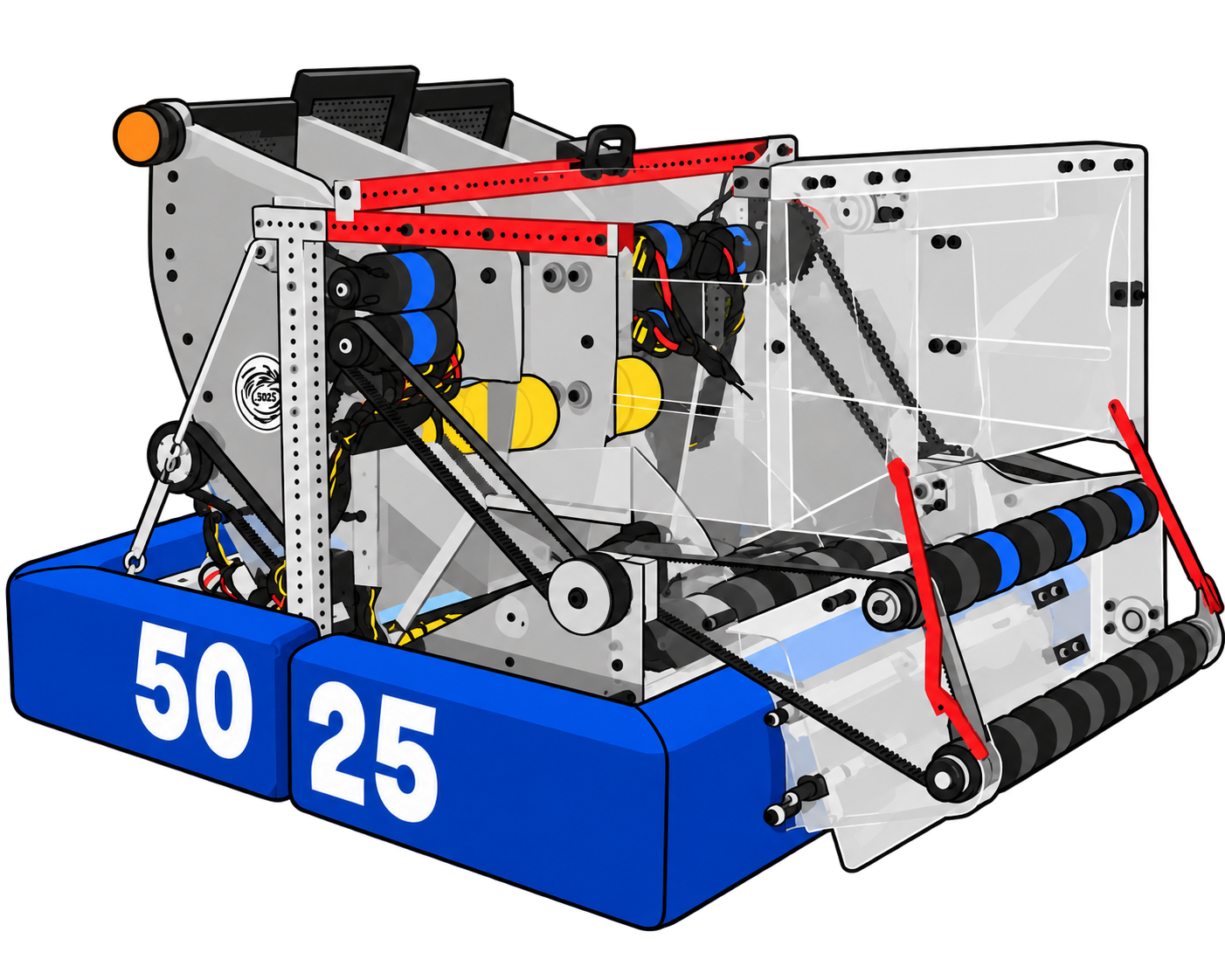
The simulator uses 5025’s supplied robot dimensions, speed, and shooter specifications. Standard multiplayer follows REBUILT’s 20-second autonomous period, three-second break, 140-second teleoperated period, and alternating active hubs. Multiplayer fuel and collisions share one server simulation. Ranked solo runs locally after receiving a server-issued ticket; the server checks the reported score and periodic movement checkpoints for plausibility. Recorded controls are processed separately to reconstruct the replay; playback differences do not change accepted points.
This is an independent, simplified simulator—not an official FIRST game. Outposts have finite chute and corral supplies; human players feed automatically, with manual aim-and-throw controls in Settings. Detectable game fouls award points to the opposing alliance. Field collision geometry, pin recognition and autonomous routines remain simplified. Intent, damage, human conduct, climbing and battery behavior are not fully simulated. Team numbers identify players; they do not change the robot’s specifications.
Field features and referee rules
Based on the official TU22 manual. This browser model uses regional/district fuel thresholds. Climbing and traversal points are excluded.
Minor fouls add 5 points to the opponent; major fouls add 15. Legal contact does not invalidate a run. Impossible motion or persistent collision penetration still excludes it from ranking.
Human throws use continuous 3D flight with random aim scatter, not guaranteed scoring. Firsthand competition reports range from roughly 50% to 90% accuracy; this is not a measured league average. The simulation uses a moderate scatter estimate and shows actual makes/misses. Timing is informed by reported early practice throws; see also competition accuracy reports. Human timing, throwing accuracy, outpost corner projection, corral capacity (36 simulated fuel), field contact shapes and pin recognition are approximate. Mechanical damage, entanglement, human reach and conduct are not inferred from contact alone. Yellow/red card history across tournaments and event administration are not modeled.
Public leaderboards show nicknames and player emblems. Use a nickname rather than personal information. Privacy details →